June 1
Planarbeit.
June 2
Nachmittag mit Fahrrad Formerie. Abends Kantine gefeiert.
June 3
Untersuchung der beschädigten Döppel[…]. Meldung beim Regiment.
June 4
Meldüngregen [?] döppelglad [?]. an Abt. Zurückanverichten [?].
June 5
Planarbeit beendet. Vermessung der Stellungen.
June 6
Beginn der Invasion. Ab 13 Uhr marschbereit. Abends rege Fliegertätigkeit.
June 6th marks the beginning of the allied invasion of Western Europe, under codename Operation Overlord. British, American and Canadian forces landed on five beaches in Normandy, and carried out airborne assaults on the flanks of the landing zones. At that moment the reserve units in the rear are alerted and made ready for immediate action.
June 7
4.30 Wecken. 5-1/2 7 Fdl. Int. [?]. 7 Uhr Bombenangriff auf Bahnhof Romescamps. 18 Uhr Abmarsch zum Rgt. 20. Abfahrt über Versailles nach Falaise.
Werfer-Brigade 7 is one of the reserve units that are on full standby to be flung into action near the landing zones. The bombing of Romescamps shunting yard is carried out by British fighter-bombers in a larger effort to disrupt the movements of German troops towards the allied beachhead. The traces of this attack can be seen to this day, craters still littering the forest south of the rail tracks.
June 8
Erkundung von bereitstellungsraumen im Raum Falaise. Nacht bei Brigade in Cussy.
Cussy is a small town northwest of Caen. At that time the area was being held by the 12. SS-Panzer-Division “Hitlerjugend” against Canadian units trying to break out of the beachhead. The divisional Gefechtsstand was situated in the Ardenne Abbey, very close to Cussy.
June 9
Rühe in Cussy.
June 10
16 Uhr Abfahrt zür Lageerkundung über Caen nach Carpiquet. Dann Züruckfahrt nach Cussy, dort Abfahrt 7.30 Uhr. Bombardement auf Falaise. 15 Uhr zurück zür Battr.
June 11
15 Uhr Zuruck zur Batterie in Buron. 19 Uhr F. St. in La Folie bezogen.
Buron is a neighbouring village of both Cussy and the Ardenne Abbey and was the site of intense fighting between the 12. SS-Panzer-Division “Hitlerjugend” and Canadian and British troops. On June 11 the division was attacked by the 46th Royal Marine Commando at Rots. The battery at La Folie very probably provided fire support during these defensive actions.
June 12
7.30 Abmarsch auf V.B. bei Gruppe Waldmüller (H.J. Div). Rege Artilleriefeuer beiderseits.
The V.B. (forward observer) of Gruppe Waldmüller, I./Panzer-Grenadier-Regiment 25, was very probably sited in the towers of Ardenne Abbey. The Kriegstagebuch of I./25 reports the attachment of a V.B. to the unit on that day: ‘A rocket launcher Abteilung has been attached to the Regiment, V.B. to the I./25. The commander of the rocket launcher Abteilung visits the Battalion commander at 19.00 hours for a briefing on the situation‘ [Meyer 2005].
June 13
Starker Störungsfeuer auf unsere Stellung. Bin recht kaputt und verzweifelt. Erhalte Post abends. Schwerer Art. u. s.Gr.W. feuer. Spahtrupp auf Cambes.
He writes that he is exhausted and desperate at this moment. He just carried out his first combat actions in Normandy, and very possibly fired his first shots in anger during the days before. The allied material superiority maybe also had effects on his morale.
June 14
½ 2 Uhr Abmarschbefehl mit Abt. Kdr. zur Battr. nach Baron [?]. 9 Uhr ab nach Raum Notre Dame. Habe mich schön rasiert und gewaschen. 7 Uhr geschlafen.
The reason he went to Notre Dame is probably to reconnoitre the area of operations for the days to come.
June 15
11.30 Abmarsch zur Bereitstellungsraum Janville.
June 16
4.30 Feuerschlag von 7.
und 8.Brigade, dann Stellungswechsel 2 zur westl. Troarn. Inf. Sicherung von F. St. Geschütz [?] und dort [?] Evakuiert. Angriff abgeschmiert [?].
The Brigade was removed from the front line north-west of Caen and inserted in the German lines to the south of the British bridgehead over the Orne, which was initially secured by British airborne forces. German units were to make a coordinated attack on the bridgehead after June 20, for which Werfer-Brigade 7 (but also 8 and 9) was to carry out fire support and preparatory fire. Werfer-Regiment 83 was probably in direct support of the 346. Infanterie-Division. The attack on the bridgehead never materialized in full force. Meanwhile, British forces also conducted a number of offensive actions around Caen, which ensued in heavy fighting with heavy losses on both sides. This is also illustrated in the diary, as the diary writers’ unit had to secure their own fire position as infantry.
June 17
Bis 11 Uhr geschlafen. Angriff nicht fortgesetzt. Feindl. Gegenstoss wird erwartet, wieder Sicherung übernommen. Geschütz total geplündert vorgefunden [?].
June 18
4 Uhr früh 5. Battr. wird durch Spähtrupp ausgeschossen[?], Gelände durchgekämmt. Pferde am Geschutz [?] raus gelassen [?]. Hengsten gefuttert [?]. Tross gefahren. Stiefel erhalten. Grossche [?] gekommen.
June 19
Starker Regenwetter. Fast die ganzen Tag geschlafen. Fühle mich krank.
June 20
Fühle mich noch immer krank. Bin sehr müde und kaputt. Es soll Stellungswechsel kommen.
He writes that he is feeling ill and very exhausted, and reports the same for a number of consecutive days. The fighting east of Caen was very intense, with the British airborne units putting up stiff resistance against German efforts to crush the bridgehead east of the Orne river. The intensity of the battle probably had a very profound effect on him.
June 21
Zür H.K.L. vorgegangen. Kampffeld schwer verwustet. Nach Rückkehr erhalte ich Post.
June 22
Fühle mich noch immer krank. Post erhalten.
June 23
Auf Bat. Gef. St. gefahren. Wir gehen 1km zuruck. 6. Werfer macht abends Stellungswechsel.
June 24
1.30-4.30 Feuerbereitschaft. Mit K. rad auf Batr. Gef. St. gewesen (Chateau). Obgefr. Kopp gefallen.
June 25
24.00 Uhr feindl. Angriff wird abgewehrt durch konzentrierter Art. ü Werferfeuer. 100 […]. Nachmittags zur Bois de Bavent gewesen. Bat. Gef. St. Damwild [?] geheben [?].
Bois de Bavent formed the eastern edge of the British bridgehead over the Orne. The area saw heavy clashes between the airborne troops (and later, amongst others, the 51 Highland Division) and German units.
June 26
P.K. war da. Wir wurden gefilmt. 17.30 Stellungswechsel vorbereiten.
For two days in a row the P.K., or Propaganda-Kompanie (propaganda troops), filmed and photographed the writers’ battery. Some photo’s and film material from this day has survived that shows a Nebelwerfer-battery in action. Nebelwerfer-footage is also shown in the Wochenschau nr. 722 of July 5, 1944. Under normal circumstances action footage appeared in the Wochenschau some 7-10 days after it was shot, so it is a very real possibility that the battery is shown in this broadcast. So it can be assumed we have moving images of the writers’ battery, and possibly also from the writer himself. Wochenschau 722 can be viewed here (minute 11 onwards).
June 27
1.30 Stellungswechsel zur Bereitstellungsraum St. May 1.0. 14u Abmarsch zur Feuerstellung. 3 km zuruckgegangen, da Tommy in Baron. P.K. filmt Battr. Stellung. Nachts Battr. Infanteristisch […] eingesetzt.
The German front line was pushed back north and west of Hill 112 due to an attack in force by the British VIII Corps, which crushed three battalions of the 12. SS-Panzer-Division “Hitlerjugend”. June 26 marked the beginning of the British Operation Epsom, the ultimate objective of which was to encircle and liberate Caen. The immediate objective south-west of Caen was to secure the crossing points over the river Odon. The resulting bridgehead south of the river was to be secured, and to this end tanks of the 23rd Hussars reached Baron-sur-Odon on June 27/28. To the east of the village lay Hill 112, a height that commanded the entire area and that would form the focus of battle for weeks to come.
June 28
Morgens soll angegriffen worden. Angrif bleibt liegen. Spahtrupp auf Panzer gemacht. 7 P4 [?] zum Angriff eingewiesen. Stellungswechsel nach Athis und Ornetal. Abend zum V.B. nach Verson gefahren, auf Ruckfahrt ca. 2 km ins Feindgelande gefahren.
From the observation post in Verson the V.B. would have had a good view of Carpiquet airfield and its surroundings, as well as Hill 112. This airfield and Hill 112 were the core objectives of British operations south-west of Caen. This days counterattack was to be conducted by one Panzerkompanie of 21. Panzer-Division, the available units of the 12. SS Artillerieregiment and Werfer-Regiment 83. The objectives were to recapture Mouen and Colleville and establish contact with the Weidinger Kampfgruppe near Grainville.
June 29
In der Brunn gebadet. B-Stelle in Eterville bezogen. Einen Wagen voll Wein geholt. Abends starkerer Art. Verschuss auf Eterville.
The writer probably had his B-Stelle in the church tower of Eterville, from which Hill 112, Verson and part of the upper Odon Valley can be observed.
June 30
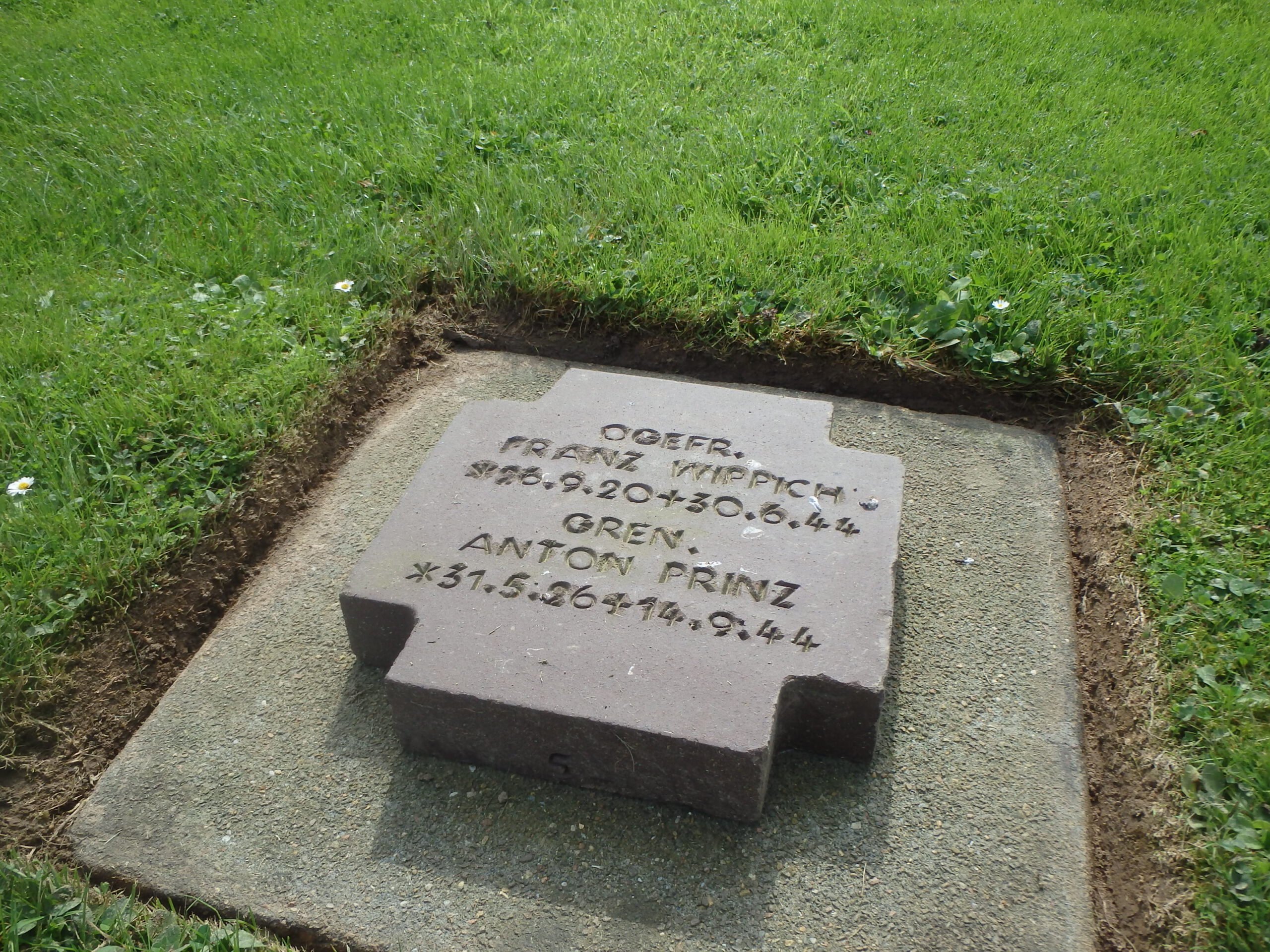
Eigene Truppen liegen schon auf zu Hohen vor uns. Feindpanzer haben sich zuruckgezogen. Uffz. Koar, Ogefr. Wippich gefallen, 3 Verwundeten in Feuerstellung. Post erhalten.
On June 30, consecutive strong German counterattacks by the 9., 10. and 12. SS-Panzer-Division forced the British to abandon some of their positions east of the Odon, amongst which those on Hill 112 (the height that is mentioned in the diary), after heavy losses. Due to these counterattacks Operation Epsom was abandoned by general Dempsey. The Nebelwerfer of Werfer-Regiment 83 proved to play a vital part in the attack on Hill 112 that day. Untersturmführer Willi Kändler of Panzer-Regiment 12 reported on this attack: ‘Early in the morning, rockets from our launchers, trailing veils of smoke, howled into the English positions in the small square wood. These launchers decided the success of the attack during that morning. This was our fourth attack on Hill 112, and it was crowned by the capture of the square wood and the hill. As we drove up, we saw numerous destroyed vehicles, amongst them knocked-out Sherman tanks‘ [Meyer 2005]. Sturmmann Erich Fugunt of the same regiment wrote: ‘The rocket lauchers were firing right above us toward the hill. The Grenadiers reported that the Tommies were on the run‘ [Meyer 2005]. Obergefreiter Franz Wippich is currently buried at La Cambe War Cemetery, Block 5, Grave 33. Unteroffizier Karl Koar is buried at the same cemetery, Block 5, Grave 32.